Smart Cities Market by Focus Area, Smart Transportation, Smart Buildings, Smart Utilities, Smart Citizen Services (Public Safety, Smart Healthcare, Smart Education, Smart Lighting, and E-Governance) - Global Forecast to 2032

icon1
USD 1796.22 BN
MARKET SIZE, 2032
icon2
CAGR 14.3%
(2026-2032)
icon3
350
REPORT PAGES
icon4
300
MARKET TABLES

OVERVIEW

smart-cities-market Overview

Source: Secondary Research, Interviews with Experts, MarketsandMarkets Analysis

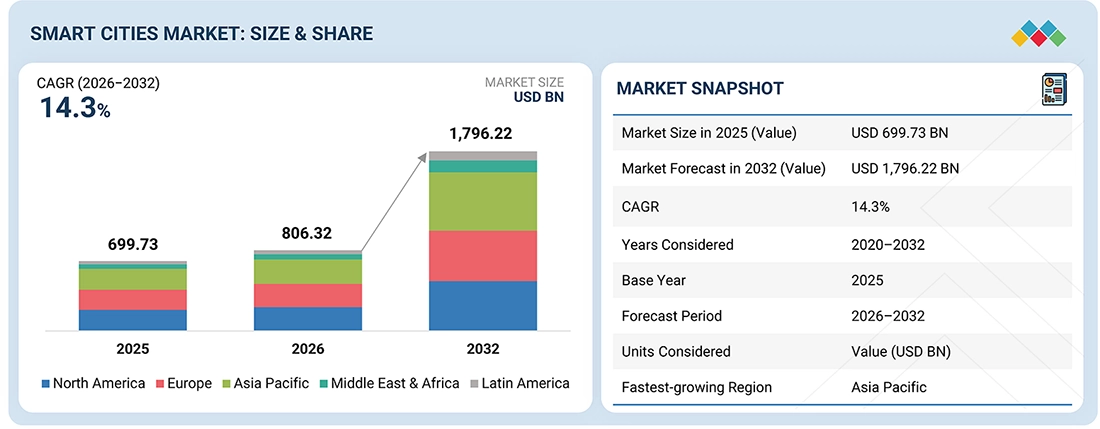
The global smart cities market is expected to grow from USD 806.32 billion in 2026 to USD 1,796.22 billion by 2032, with a CAGR of 14.3% during this period. The smart cities market is driven by the convergence of socio-economic, environmental, and technological factors that are transforming urban development worldwide. Governments and cities are increasingly investing in smart infrastructure as an alternative way of solving issues such as traffic congestion, energy consumption, waste management, and public safety. Concurrently, the development of enabling technologies, such as the Internet of Things (IoT), artificial intelligence (AI), and 5G connectivity, enable real-time collection of and analysis of data, helping improve decision-making and efficient delivery of services. Moreover, increased concerns over the environment with regard to international commitments on climate continue to make cities transition towards more efficient, low-carbon solutions. Favorable policies and public-private collaborations further drive the implementation of smart technologies. Collectively, these drivers are fostering the growth of integrated, technology-enabled urban ecosystems that form the foundation of the smart cities market.

Market Size and Forecast:

  • Market Size in 2025: USD 699.73 Billion
  • 2026 Market Size: USD 806.32 Billion
  • 2032 Forecasted Market Size: USD 1,796.22 Billion
  • Growth Rate (2026-2032): CAGR of 14.3%
  • Forecast period: 2026–2032

Key Market Trends and Insights

  • Growth Opportunities: Expands via smart infrastructure, connected utilities, intelligent mobility, green buildings, and e-services.
  • Key Technologies: Powered by AI, machine learning, IoT, big data analytics, 5G connectivity, cloud, and edge computing.
  • By Focus Area: Smart Citizen Services holds the largest share due to healthcare, safety, education, lighting, and e-governance.
  • AI Impact: AI traffic optimization, predictive maintenance, energy management, and safety analytics boost urban efficiency.

KEY TAKEAWAYS

  • By Focus Area
    Smart citizen services is expected to hold the largest market share during the forecast year.
  • By Smart Buildings
    The commercial segment is expected to hold the largest market share during the forecast period.
  • By Region
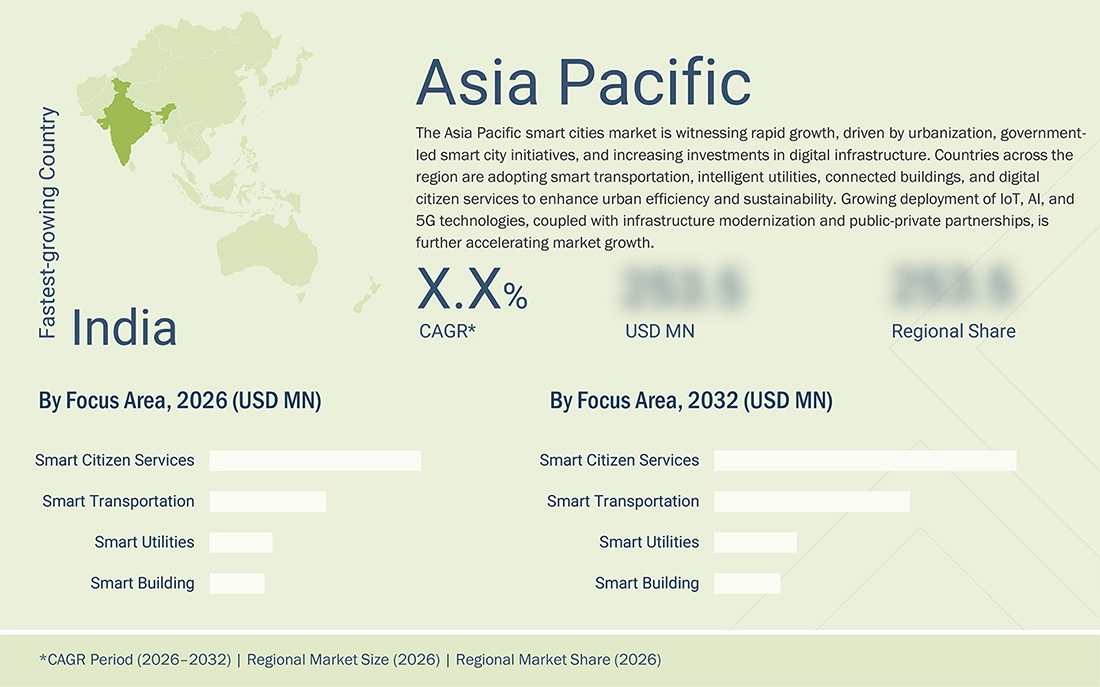
    The Asia Pacific region is projected to grow the fastest from 2026 to 2032.
  • Competitive Landscape – Key Players
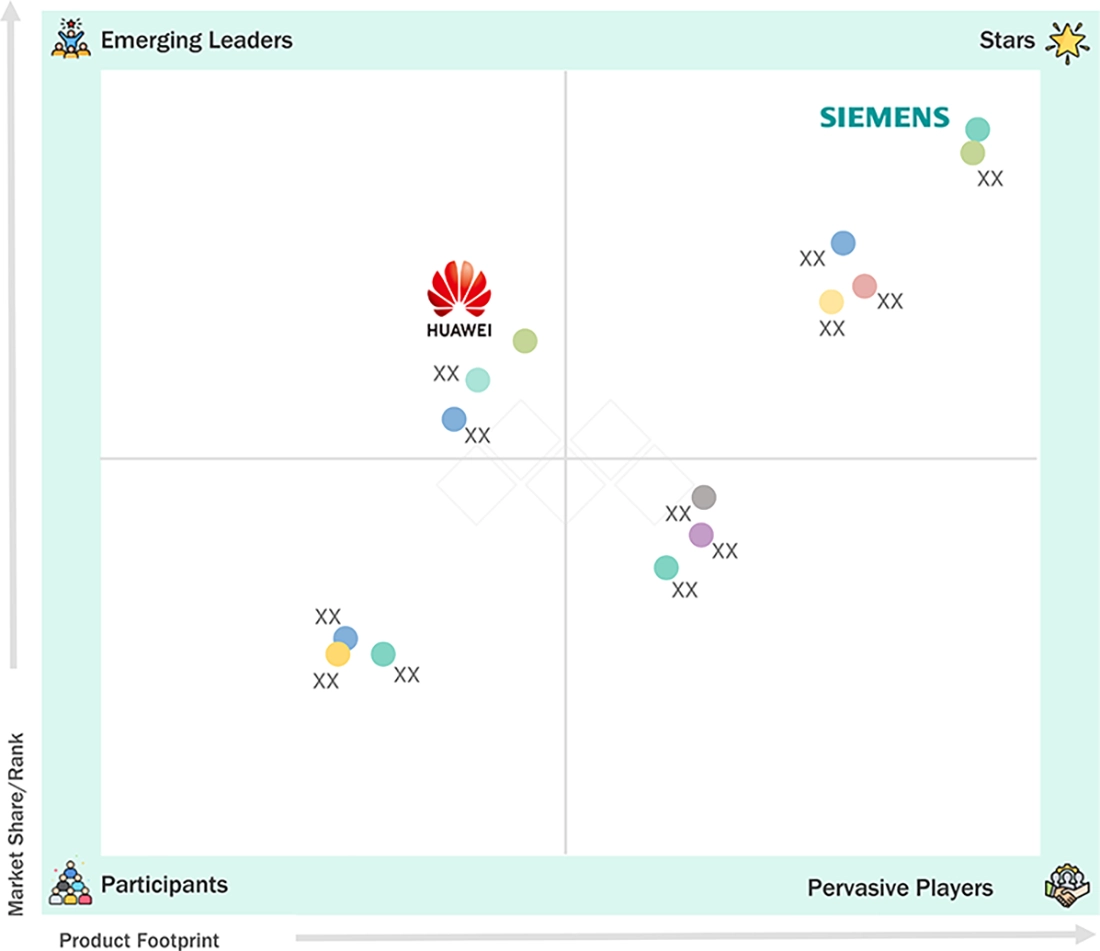
    Companies such as Siemens, Cisco, Hitachi, IBM, and Microsoft were identified as some of the star players in the smart cities market, given their strong market share and product footprint.
  • Competitive Landscape – Startup/SME
    Companies such as AppyWay, Signify, and GAIA Technologies were identified as some of the progressive players in the smart cities market, given their strong market share and product footprint.

The increasing adoption of IoT, artificial intelligence (AI), cloud computing, and advanced connectivity is driving demand for smart city solutions. Governments and municipalities require efficient, sustainable, and integrated systems to manage transportation, energy, water, waste, public safety, and citizen services. Smart cities address these needs through real-time monitoring, intelligent traffic management, automated operations, and data-driven urban planning. Growing deployment of 5G networks, connected sensors, digital twins, smart grids, and integrated city platforms is further accelerating market growth. Cities are investing in smart technologies to reduce congestion, improve service delivery, optimize resource utilization, enhance public safety, lower carbon emissions, and build resilient urban environments while improving residents' quality of life.

TRENDS & DISRUPTIONS IMPACTING CUSTOMERS' CUSTOMERS

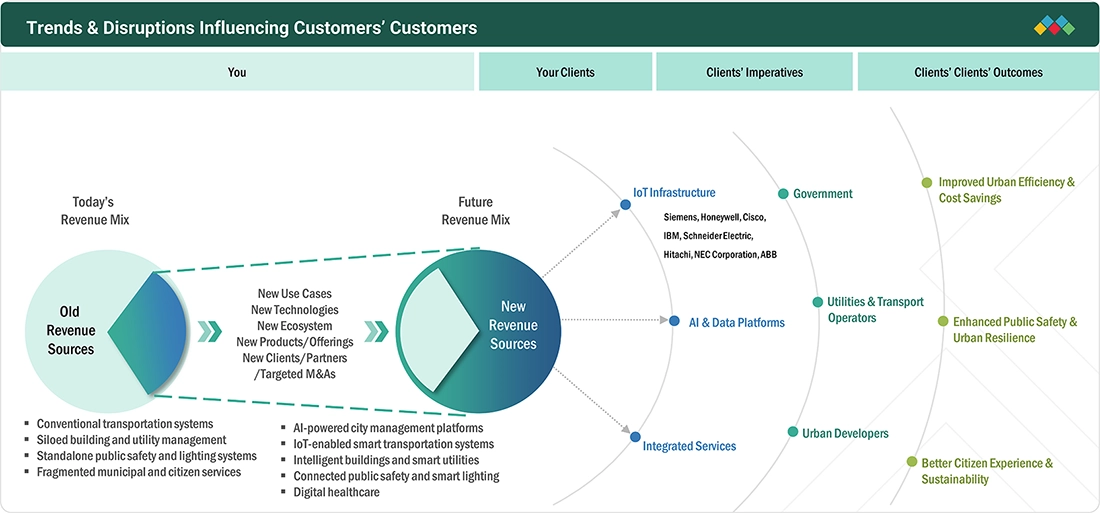
The smart cities market is undergoing a significant transformation, driven by the adoption of AI, IoT, connected infrastructure, and integrated city management platforms. Traditional urban systems are evolving toward intelligent transportation, smart utilities, digital public services, and automated infrastructure management. Growing investments by governments, utility operators, and urban developers are accelerating this transition, enabling improved operational efficiency, reduced costs, enhanced public safety, greater sustainability, and better citizen experiences.

smart-cities-market Disruptions

Source: Secondary Research, Interviews with Experts, MarketsandMarkets Analysis

MARKET DYNAMICS

Drivers
Impact
Level
  • Growing urbanization across regions
  • Use of artificial intelligence and machine learning in urban development
RESTRAINTS
Impact
Level
  • Privacy and security concerns
  • High cost of implementation
OPPORTUNITIES
Impact
Level
  • Advancements in AI, cloud, IoT, and analytics technologies
  • Rise of 5G technology
CHALLENGES
Impact
Level
  • Achieving future-readiness of smart cities for sustainable living
  • Absence of suitable infrastructure in emerging economies

Source: Secondary Research, Interviews with Experts, MarketsandMarkets Analysis

Driver: Growing urbanization across regions

The adoption of smart cities is increasing due to the rising rate of urbanization worldwide. According to the UN’s World Urbanization Prospects, 56.2% of the global population was expected to live in urban areas in 2020, with that figure projected to reach 68% by 2050. This population growth will likely heighten the demand for smart city solutions, such as smart buildings that optimize space utilization, as well as smart transportation and traffic management systems designed to alleviate urban congestion. The implementation of these smart city solutions, along with advancements in IoT systems, will facilitate the needs of the growing population in the coming years. Governments across various countries are launching numerous smart city initiatives to provide advanced services to their citizens. Emerging economies like China, Malaysia, Hong Kong, and India are making significant investments in smart city projects. Additionally, the Chinese government has announced its third phase of the smart city development initiative, which encompasses nearly 590 cities nationwide.

Restraint: Privacy and security concerns

Privacy and security are significant concerns in smart city projects. The entire ecosystem is highly vulnerable because smart cities rely heavily on the Internet of Things (IoT) and centralized access points to manage various data streams. To effectively tackle the privacy and security challenges in smart cities, stakeholders—including security professionals and smart city planners—must address these issues in a comprehensive manner. This approach will help ensure that such challenges do not continue to affect the broader smart network.

Opportunity: Advancements in AI, cloud, IoT, and analytics technologies

In recent years, there have been rapid advancements in emerging technologies such as artificial intelligence (AI), machine learning (ML), cloud computing, data analytics, the Internet of Things (IoT), and cybersecurity. The increased adoption of these technologies in smart cities has significantly improved connectivity, leading to a complete transformation of the smart city ecosystem. IoT devices enable the collection of data from various sources, which can then be shared with a centralized control center through the cloud. These advanced technologies not only enhance the quality of life for citizens but also improve areas such as security, privacy, and environmental sustainability.

Challenge: Achieving future-readiness of smart cities for sustainable living

In the quest to develop smart cities in the digital age, various challenges arise that require careful thought and strategic solutions. In addition to the existing legal, regulatory, and socio-economic factors present in regional markets, key stakeholders face obstacles related to cybersecurity, data stewardship, and ownership. The need for interoperability and cross-border data portability further complicates the situation, necessitating collaborative efforts to create seamless smart city ecosystems. Moreover, it is essential to demonstrate environmental, social, and governance (ESG) awareness through reliable metrics to ensure sustainable urban development. In today’s highly volatile, risk-prone, hyper-connected, and virtualized economy, business leaders must adapt by creating innovative business models that meet the unique demands of the digital era. Traditional approaches no longer suffice; a paradigm shift is necessary to design and build future-ready, sustainable urban environments that prioritize the well-being of future generations.

SMART CITIES MARKET: COMMERCIAL USE CASES ACROSS INDUSTRIES

COMPANY USE CASE DESCRIPTION BENEFITS
company logo
Indore, India: Schneider Electric deployed its EcoStruxure Asset Advisor for Atal Indore City Transport, enabling remote monitoring of 21 substations through connected UPS systems, predictive analytics, and automated maintenance capabilities to improve public transportation infrastructure reliability. The solution achieved 80% improvement in time optimization and 30% cost optimization. Continuous monitoring reduced manual inspections, improved maintenance efficiency, and enabled faster identification of equipment issues, supporting safer and more reliable public transportation operations.
company logo
Vijayawada, India: Cisco partnered with the Andhra Pradesh government to develop the Golden Mile smart street project, integrating connected street lighting, public Wi-Fi, environmental monitoring, intelligent transportation, and digital citizen services across a three-kilometer urban corridor. An assessment reported approximately 70% lower electricity consumption for monitored smart streetlights compared with conventional LED lights. The project also enhanced connectivity, enabled centralized lighting management, improved public safety capabilities, and expanded access to digital municipal services.
company logo
Rio de Janeiro, Brazil: IBM supported the development of an integrated city operations center, connecting municipal agencies, transportation networks, weather monitoring, and emergency services through real-time analytics and predictive technologies to improve urban management and disaster response coordination. The center integrated information from 30 municipal agencies, enabling 24/7 city monitoring. IBM's forecasting technology can predict heavy rainfall up to 48 hours in advance, supporting improved emergency preparedness, coordinated incident response, and more efficient municipal operations.

Logos and trademarks shown above are the property of their respective owners. Their use here is for informational and illustrative purposes only.

MARKET ECOSYSTEM

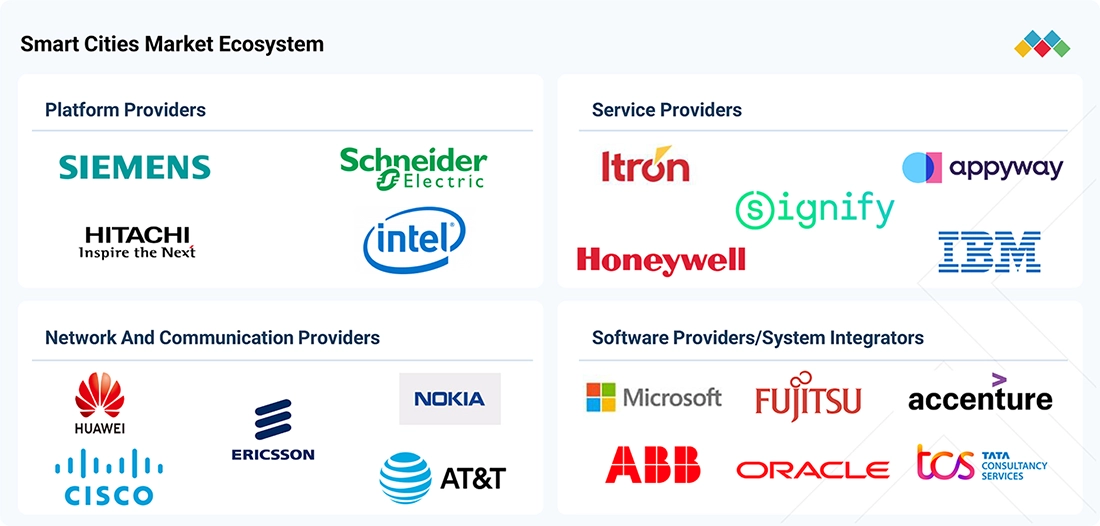
The smart cities market ecosystem comprises platform providers, service providers, network and communication providers, and software providers/system integrators, collectively enabling intelligent and sustainable urban development. Platform providers such as Siemens, Schneider Electric, and Hitachi deliver integrated solutions for managing urban infrastructure. Service providers, including IBM, Honeywell, and Signify, support smart city operations through specialized services and technologies. Network and communication providers such as Huawei, Ericsson, Nokia, and Cisco enable seamless connectivity and data exchange. Software providers and system integrators, including Microsoft, Oracle, Accenture, and TCS, facilitate data analytics, cloud integration, and intelligent city management, enhancing operational efficiency, sustainability, and citizen experiences.

smart-cities-market Ecosystem

Logos and trademarks shown above are the property of their respective owners. Their use here is for informational and illustrative purposes only.

MARKET SEGMENTS

smart-cities-market Segments

Source: Secondary Research, Interviews with Experts, MarketsandMarkets Analysis

Smart Cities Market, By Focus Area

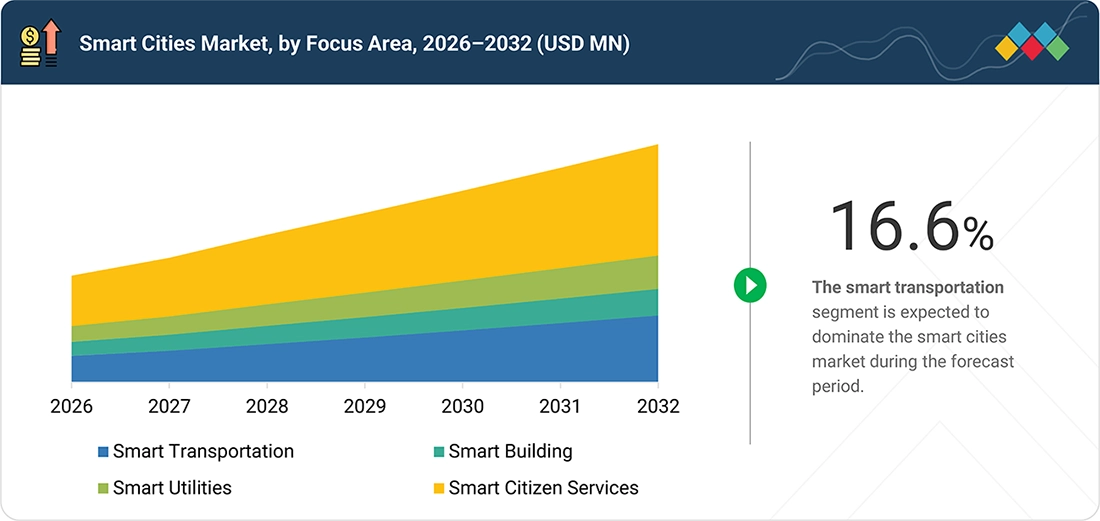
The smart transportation segment is witnessing significant growth, driven by rapid urbanization, increasing traffic congestion, and growing demand for efficient, sustainable mobility solutions. Governments and transportation authorities are investing in intelligent transportation systems (ITS), smart traffic management, automated fare collection, passenger information systems, and connected logistics to improve urban mobility and transportation efficiency. The integration of artificial intelligence (AI), Internet of Things (IoT), 5G connectivity, and advanced analytics enables real-time traffic monitoring, predictive congestion management, route optimization, and improved passenger experiences. Additionally, the increasing adoption of connected vehicles, smart parking solutions, and integrated mobility platforms is creating opportunities for transportation infrastructure modernization. Government initiatives promoting sustainable transportation, reduced carbon emissions, and improved road safety are further accelerating market growth. As cities prioritize seamless connectivity, efficient public transportation, and intelligent mobility ecosystems, smart transportation solutions are becoming increasingly important for developing sustainable and resilient urban environments.

Smart Cities Market, By Smart Transportation

The traffic management segment is experiencing strong growth, supported by increasing urban traffic congestion, rising vehicle ownership, and growing investments in intelligent transportation infrastructure. Governments and municipal authorities are deploying adaptive traffic signal control systems, intelligent surveillance cameras, connected road sensors, and centralized traffic management platforms to improve traffic flow and road safety. The integration of AI, machine learning, IoT, and real-time data analytics enables predictive traffic monitoring, automated incident detection, congestion forecasting, and dynamic route optimization. Additionally, the expansion of connected vehicle technologies and vehicle-to-infrastructure (V2I) communication is enhancing coordination between transportation networks and road users. Increasing emphasis on reducing travel time, fuel consumption, and transportation-related emissions is further driving adoption. As cities focus on optimizing existing road infrastructure and improving emergency response capabilities, advanced traffic management solutions are expected to play an increasingly important role in smart urban mobility.

Smart Cities Market, By Smart Buildings

The energy management segment is gaining significant traction, driven by increasing energy consumption, rising electricity costs, and growing emphasis on sustainable building operations. Commercial, residential, and industrial building owners are adopting intelligent energy management systems to monitor, control, and optimize electricity consumption across lighting, heating, ventilation, air conditioning (HVAC), and other building operations. The integration of IoT sensors, AI-powered analytics, smart meters, and automated building management systems enables real-time energy monitoring, demand forecasting, predictive maintenance, and improved energy efficiency. Additionally, increasing adoption of renewable energy integration, energy storage systems, and demand-response technologies is supporting the transition toward low-carbon buildings. Government regulations promoting energy efficiency, green building certifications, and carbon emission reduction targets are further accelerating market adoption. As organizations prioritize operational cost savings, sustainability objectives, and improved building performance, intelligent energy management solutions are becoming essential components of smart building infrastructure and sustainable urban development.

Smart Cities Market, By Smart Utilities

The advanced metering infrastructure (AMI) segment is experiencing substantial growth, driven by the modernization of utility networks, increasing demand for efficient energy distribution, and growing adoption of smart grid technologies. Utility providers are deploying smart electricity, gas, and water meters integrated with two-way communication networks and meter data management systems to enable automated consumption monitoring, remote meter reading, and improved billing accuracy. The integration of IoT, cloud computing, AI, and advanced analytics enables real-time consumption tracking, outage detection, demand forecasting, and efficient resource allocation. Additionally, the growing emphasis on reducing transmission and distribution losses, improving energy conservation, and supporting demand-response programs is accelerating AMI deployment. Government-led smart grid initiatives, aging utility infrastructure modernization, and increasing renewable energy integration are further supporting market expansion. As utilities prioritize operational efficiency, network reliability, and improved customer engagement, advanced metering infrastructure is becoming an essential component of intelligent and sustainable urban utility management.

Smart Cities Market, By Smart Citizen Services

The smart healthcare segment is witnessing rapid growth, driven by increasing demand for accessible healthcare services, rising healthcare expenditures, and growing adoption of digital health technologies. Governments, healthcare providers, and municipalities are investing in telemedicine platforms, remote patient monitoring systems, connected medical devices, and intelligent hospital management solutions to improve healthcare accessibility and service delivery. The integration of AI, IoT, cloud computing, and advanced data analytics enables real-time patient monitoring, predictive diagnostics, automated healthcare workflows, and data-driven clinical decision-making. Additionally, the growing adoption of electronic health records, wearable health devices, and AI-powered diagnostic systems is supporting the development of connected healthcare ecosystems. Increasing prevalence of chronic diseases, aging populations, and government initiatives promoting digital healthcare infrastructure are further accelerating market growth. As cities focus on strengthening healthcare accessibility, improving patient outcomes, and optimizing medical resources, smart healthcare solutions are becoming increasingly important components of citizen-centric urban development.

REGION

Asia Pacific to register the highest CAGR during the forecast period

Asia Pacific is expected to register the highest CAGR in the global smart cities market during the forecast period, driven by rapid urbanization, increasing population density, and substantial government investments in digital infrastructure. Countries such as China, India, Japan, South Korea, and Singapore are actively implementing smart city initiatives to improve urban mobility, energy efficiency, public safety, and citizen services. The growing adoption of artificial intelligence (AI), Internet of Things (IoT), 5G connectivity, cloud computing, and advanced analytics is accelerating the deployment of intelligent transportation systems, smart buildings, connected utilities, and digital governance platforms. Additionally, government-led programs, public-private partnerships, and increasing investments in sustainable urban infrastructure are creating significant market opportunities. Rising demand for efficient resource management, reduced traffic congestion, and improved quality of life is further supporting regional growth.

smart-cities-market Region

SMART CITIES MARKET: COMPANY EVALUATION MATRIX

In the smart cities market matrix, Siemens (Star Player) leads with its strong global presence, comprehensive portfolio of smart transportation, building, and energy solutions, and expertise in digitalization, automation, and connected urban infrastructure. Huawei (Emerging Leader) is strengthening its position through smart city platforms, 5G connectivity, AI-powered city operations, IoT solutions, and intelligent transportation technologies to support efficient, connected, sustainable, and citizen-centric urban development.

smart-cities-market Evaluation Metrics

Source: Secondary Research, Interviews with Experts, MarketsandMarkets Analysis

KEY MARKET PLAYERS

  • Siemens (Germany)
  • Cisco (US)
  • Hitachi (Japan)
  • IBM (US)
  • Microsoft (US)
  • Schneider Electric (France)
  • Huawei (China)
  • NEC Corporation (Japan)
  • ABB (Switzerland)
  • Sutherland (US)
  • Ericsson (Sweden)
  • Oracle (US)
  • Fujitsu (Japan)
  • Honeywell (US)
  • Accenture (Ireland)
  • Vodafone (UK)
  • AWS (US)
  • Thales (France)
  • Signify (Netherlands)
  • Motorola (US)
  • TCS (India)
  • AT&T (US)
  • Nokia (Finland)
  • Samsung (South Korea)
  • SAP (Germany)
  • TomTom (Netherlands)
  • AppyWay (UK)
  • Ketos (US)
  • Gaia (India)
  • TaKaDu (Israel)
  • Zencity (Israel)
  • Itron (US)
  • Landis+Gyr (Switzerland)
  • INRIX (US)

MARKET SCOPE

REPORT METRIC DETAILS
Market Size in 2025 (Value) USD 699.73 Billion
Market Forecast in 2026 (Value) USD 806.32 Billion
Market Forecast in 2032 (Value) USD 1,796.22 Billion
Growth Rate CAGR of 14.3% during 2026–2032
Years Considered 2020–2032
Base Year 2025
Forecast Period 2026–2032
Units Considered Value (USD Billion)
Report Coverage Revenue forecast, company ranking, competitive landscape, growth factors, and trends
Segments Covered
  • Focus Area:
    • Smart Transportation
    • Smart Buildings
    • Smart Utilities
    • Smart Citizen Services
  • Smart Utilities:
    • Offering (Solutions
    • Services)
    • Type
  • Smart Buildings:
    • Offering (Solutions
    • Services)
    • Type
  • Smart Transportation:
    • Offering (Solutions
    • Services)
    • Type
  • Smart Citizen Services:
    • Smart Education
    • Smart Healthcare
    • Smart Public Safety
    • Smart Lighting
    • E-Governance
Regions Covered North America, Europe, Asia Pacific, Middle East and Africa, Latin America

WHAT IS IN IT FOR YOU: SMART CITIES MARKET REPORT CONTENT GUIDE

smart-cities-market Content Guide

DELIVERED CUSTOMIZATIONS

We have successfully delivered the following deep-dive customizations:

CLIENT REQUEST CUSTOMIZATION DELIVERED VALUE ADDS
Company Information Detailed analysis and profiling of additional market players (up to five)
  • Broadens competitive insights, helping clients make informed strategic and investment decisions
  • Reveals market gaps and opportunities, supporting differentiation and targeted growth initiatives

RECENT DEVELOPMENTS

  • May 2026 : Siemens launched Asset Performance Advanced, an AI-enabled service within its Building X ecosystem. It combines predictive failure classification, fault detection and diagnosis, and AI-guided workflows to improve asset reliability, energy performance, maintenance efficiency, and building operations.
  • June 2025 : Schneider Electric partnered with The Mobility House Solutions (TMH) to jointly offer smart charging and energy management for electric vehicle fleets. The deal brings together Schneider’s energy management/automation and TMH’s smart-charging tech to simplify deployment of in-depot and on-the-road charging (buses, trucks, etc.). The partnership aims to optimize grid connection and energy use for fleets, accelerating e-mobility adoption. This ties into Schneider’s smart cities strategy by expanding EV infrastructure and intelligent energy services in urban transport networks.
  • March 2025 : ABB signed an MoU with Canada’s Charbone Hydrogen to supply electrical substations for up to 15 modular green hydrogen plants across North America. ABB will standardize electrical housing and may provide a broader automation scope. This partnership (renewable energy infrastructure) contributes to smart city/industry decarbonization goals (clean fuel for transportation and industry) in line with ABB’s sustainability focus.
  • February 2025 : The King Abdullah Financial District (KAFD) signed an MoU with Huawei at LEAP 2025 to develop advanced smart city and AI technologies. The collaboration will deploy cutting-edge technologies (WiFi-7, 5G-A, AI/IoT, cloud, smart poles) across KAFD’s 1.6 million m² district. Huawei will support KAFD’s digital infrastructure and smart city platforms (smart lighting, environmental sensing, and sustainable energy), aligning with Saudi Vision 2030. This partnership is a clear smart cities initiative: it leverages Huawei’s telecom and AI stack to accelerate urban innovation and digital infrastructure in a major smart district.


Table of Contents

checkmarkExclusive indicates content/data unique to MarketsandMarkets and not available with any competitors.

TITLE
PAGE NO
1
INTRODUCTION


15
2
EXECUTIVE SUMMARY


3
PREMIUM INSIGHTS


4
MARKET OVERVIEW
Outlines emerging trends, technology impact, and regulatory signals affecting growth trajectory and stakeholder decisions.


4.1
MARKET DYNAMICS


4.1.1
DRIVERS


4.1.2
RESTRAINTS


4.1.3
OPPORTUNITIES


4.1.4
CHALLENGES


4.2
INTERCONNECTED MARKETS AND CROSS-SECTOR OPPORTUNITIES


4.3
STRATEGIC MOVES BY TIER-1/2/3 PLAYERS


5
INDUSTRY TRENDS
This section summarizes market dynamics, key shifts, and high-impact trends shaping demand outlook.


5.1
PORTER’S FIVE FORCES ANALYSIS


5.1.1
THREAT OF NEW ENTRANTS


5.1.2
THREAT OF SUBSTITUTES


5.1.3
BARGAINING POWER OF SUPPLIERS


5.1.4
BARGAINING POWER OF BUYERS


5.1.5
INTENSITY OF COMPETITIVE RIVALRY


5.2
MACROECONOMIC INDICATORS


5.2.1
INTRODUCTION


5.2.2
GDP TRENDS AND FORECAST


5.2.3
TRENDS IN SMART CITIES INDUSTRY


5.3
VALUE/SUPPLY CHAIN ANALYSIS


5.4
ECOSYSTEM ANALYSIS


5.5
PRICING ANALYSIS


5.5.1
AVERAGE SELLING PRICE TREND OF KEY PLAYERS, BY FOCUS AREA,


5.5.2
INDICATIVE PRICING ANALYSIS, BY SOLUTION,


5.6
KEY CONFERENCES AND EVENTS, 2026–2027


5.7
TRENDS/DISRUPTIONS IMPACTING CUSTOMERS’ BUSINESS


5.8
INVESTMENT AND FUNDING SCENARIO


5.9
CASE STUDY ANALYSIS


5.10
IMPACT OF 2025 US TARIFF ON THE SMART CITIES MARKET


5.10.1
KEY TARIFF RATES


5.10.2
PRICE IMPACT ANALYSIS


5.10.3
IMPACT ON END-USE INDUSTRIES
 
 
6
STRATEGIC DISRUPTIONS THROUGH TECHNOLOGY, PATENTS, DIGITAL, AND AI ADOPTION


6.1
KEY EMERGING TECHNOLOGIES


6.2
COMPLEMENTARY TECHNOLOGIES


6.3
TECHNOLOGY/PRODUCT ROADMAP


6.4
PATENT ANALYSIS


6.5
IMPACT OF AI/GEN AI ON SMART CITIES MARKET


6.5.1
TOP USE CASES AND MARKET POTENTIAL


6.5.2
CASE STUDIES OF AI IMPLEMENTATION IN THE SMART CITIES MARKET


6.5.3
INTERCONNECTED ADJACENT ECOSYSTEM AND IMPACT ON MARKET PLAYERS


6.5.4
CLIENTS’ READINESS TO ADOPT GENERATIVE AI IN THE SMART CITIES
 
 
7
REGULATORY LANDSCAPE AND SUSTAINABILITY INITIATIVES


7.1
REGIONAL REGULATIONS AND COMPLIANCE


7.1.1
REGULATORY BODIES, GOVERNMENT AGENCIES, AND OTHER ORGANIZATIONS


7.1.2
INDUSTRY STANDARDS


7.2
SUSTAINABILITY INITIATIVES


7.3
IMPACT OF REGULATORY POLICIES ON SUSTAINABILITY INITIATIVES


8
CUSTOMER LANDSCAPE AND BUYER BEHAVIOR


8.1
DECISION-MAKING PROCESS


8.2
BUYER STAKEHOLDERS AND BUYING EVALUATION CRITERIA


8.3
ADOPTION BARRIERS AND INTERNAL CHALLENGES


8.4
UNMET NEEDS IN VARIOUS END-USE INDUSTRIES


9
SMART CITIES MARKET, BY FOCUS AREA (MARKET SIZE & FORECAST TO 2032 – IN VALUE, USD MILLION)


FOCUS AREA WISE DEMAND POTENTIAL AND THE GROWTH PATHWAYS SHAPING SMART CITIES ADOPTION ACROSS DIVERSE INDUSTRIES


9.1
INTRODUCTION


9.2
SMART UTILITIES


9.3
SMART BUILDINGS


9.4
SMART TRANSPORTATION


9.5
SMART CITIZEN SERVICES


10
SMART CITIES MARKET, BY SMART UTILITY (MARKET SIZE & FORECAST TO 2032 – IN VALUE, USD MILLION)


SMART UTILITY WISE DEMAND POTENTIAL AND THE GROWTH PATHWAYS SHAPING SMART CITIES ADOPTION ACROSS DIVERSE INDUSTRIES


10.1
INTRODUCTION


10.2
BY COMPONENT


10.2.1
SOLUTIONS


10.2.1.1
ADVANCED METERING INFRASTRUCTURE


10.2.1.2
DISTRIBUTION MANAGEMENT SYSTEM


10.2.1.3
SUBSTATION AUTOMATION


10.2.1.4
OTHER SMART UTILITIES SOLUTIONS


10.2.2
SERVICES


10.2.2.1
CONSULTING


10.2.2.2
DEPLOYMENT & INTEGRATION


10.2.2.3
INFRASTRUCTURE MONITORING & MANAGEMENT
 
 
10.3
BY TYPE


10.3.1
ENERGY


10.3.2
GAS


10.3.3
WATER


10.3.4
OTHER TYPES
 
 
11
SMART CITIES MARKET, BY SMART BUILDING (MARKET SIZE & FORECAST TO 2032 – IN VALUE, USD MILLION)


SMART BUILDING WISE DEMAND POTENTIAL AND THE GROWTH PATHWAYS SHAPING SMART CITIES ADOPTION ACROSS DIVERSE INDUSTRIES


11.1
INTRODUCTION


11.2
BY COMPONENT


11.2.1
SOLUTIONS


11.2.1.1
BUILDING INFRASTRUCTURE MANAGEMENT


11.2.1.2
SECURITY & EMERGENCY MANAGEMENT


11.2.1.3
ENERGY MANAGEMENT


11.2.1.4
NETWORK MANAGEMENT


11.2.1.5
IWMS


11.2.2
SERVICES


11.2.2.1
CONSULTING


11.2.2.2
DEPLOYMENT & INTEGRATION


11.2.2.3
INFRASTRUCTURE MONITORING & MANAGEMENT
 
 
11.3
BY TYPE


11.3.1
RESIDENTIAL


11.3.2
COMMERCIAL


11.3.3
INDUSTRIAL
 
 
12
SMART CITIES MARKET, BY SMART TRANSPORTATION (MARKET SIZE & FORECAST TO 2032 – IN VALUE, USD MILLION)


SMART TRANSPORTATION WISE DEMAND POTENTIAL AND THE GROWTH PATHWAYS SHAPING SMART CITIES ADOPTION ACROSS DIVERSE INDUSTRIES


12.1
INTRODUCTION


12.2
BY COMPONENT


12.2.1
SOLUTIONS


12.2.1.1
SMART TICKETING


12.2.1.2
TRAFFIC MANAGEMENT


12.2.1.3
PASSENGER INFORMATION SYSTEM


12.2.1.4
CONNECTED LOGISTICS


12.2.1.5
OTHER SMART TRANSPORTATION SOLUTIONS


12.2.2
SERVICES


12.2.2.1
CONSULTING


12.2.2.2
DEPLOYMENT & INTEGRATION


12.2.2.3
INFRASTRUCTURE MONITORING & MANAGEMENT
 
 
12.3
BY TYPE


12.3.1
ROADWAYS


12.3.2
RAILWAYS


12.3.3
AIRWAYS
 
 
13
SMART CITIES MARKET, BY SMART CITIZEN SERVICE (MARKET SIZE & FORECAST TO 2032 – IN VALUE, USD MILLION)


SMART CITIZEN SERVICE WISE DEMAND POTENTIAL AND THE GROWTH PATHWAYS SHAPING SMART CITIES ADOPTION ACROSS DIVERSE INDUSTRIES


13.1
INTRODUCTION


13.2
SMART EDUCATION


13.2.1
SOLUTIONS


13.2.2
SERVICES


13.3
SMART HEALTHCARE


13.3.1
MEDICAL DEVICES


13.3.2
SYSTEMS & SOFTWARE


13.3.3
SERVICES


13.4
SMART PUBLIC SAFETY


13.4.1
SOLUTIONS


13.4.2
SERVICES


13.5
SMART LIGHTING


13.5.1
SOFTWARE


13.5.2
SERVICES


13.6
EGOVERNANCE


13.6.1
SOLUTIONS


13.6.2
SERVICES
 
 
14
SMART CITIES MARKET, BY REGION (MARKET SIZE & FORECAST TO 2032 – IN VALUE, USD MILLION)


(ASSESSING GROWTH PATTERNS, INDUSTRY FORCES, REGULATORY LANDSCAPE, AND MARKET POTENTIAL ACROSS KEY GEOGRAPHIES AND COUNTRIES)


14.1
INTRODUCTION


14.2
NORTH AMERICA


14.2.1
US


14.2.2
CANADA


14.3
EUROPE


14.3.1
UK


14.3.2
GERMANY


14.3.3
FRANCE


14.3.4
SPAIN


14.3.5
ITALY


14.3.6
REST OF EUROPE


14.4
ASIA PACIFIC


14.4.1
CHINA


14.4.2
JAPAN


14.4.3
INDIA


14.4.4
SOUTH KOREA


14.4.5
AUSTRALIA & NEW ZEALAND


14.4.6
REST OF ASIA PACIFIC


14.5
MIDDLE EAST AND AFRICA


14.5.1
UAE


14.5.2
KSA


14.5.3
SOUTH AFRICA


14.5.4
REST OF MIDDLE EAST AND AFRICA


14.6
LATIN AMERICA


14.6.1
BRAZIL


14.6.2
MEXICO


14.6.3
REST OF LATIN AMERICA
 
 
15
COMPETITIVE LANDSCAPE


15.1
OVERVIEW


15.2
KEY PLAYER STRATEGIES/RIGHT TO WIN


15.3
REVENUE ANALYSIS OF TOP 5 PLAYERS (2020–2025)


15.4
MARKET SHARE ANALYSIS,


15.5
COMPANY VALUATION AND FINANCIAL METRICS


15.6
BRAND COMPARISON


15.7
COMPANY EVALUATION MATRIX: KEY PLAYERS,


15.7.1
STARS


15.7.2
EMERGING LEADERS


15.7.3
PERVASIVE PLAYERS


15.7.4
PARTICIPANTS


15.7.5
COMPANY FOOTPRINT: KEY PLAYERS,


15.7.5.1
COMPANY FOOTPRINT


15.7.5.2
REGIONAL FOOTPRINT


15.7.5.3
FOCUS AREA FOOTPRINT
 
 
15.8
COMPANY EVALUATION MATRIX: STARTUPS/SMES,


15.8.1
PROGRESSIVE COMPANIES


15.8.2
RESPONSIVE COMPANIES


15.8.3
DYNAMIC COMPANIES


15.8.4
STARTING BLOCKS


15.8.5
COMPETITIVE BENCHMARKING: STARTUPS/SMES,


15.8.5.1
DETAILED LIST OF KEY STARTUPS/SMES


15.8.5.2
COMPETITIVE BENCHMARKING OF KEY STARTUPS/SMES
 
 
15.9
COMPETITIVE SITUATION AND TRENDS


15.9.1
PRODUCT LAUNCHES


15.9.2
DEALS


15.9.3
EXPANSIONS
 
 
16
SMART CITIES MARKET, COMPANY PROFILES


16.1
KEY PLAYERS


16.1.1
SIEMENS


16.1.2
CISCO


16.1.3
HITACHI


16.1.4
HUAWEI


16.1.5
MICROSOFT


16.1.6
SCHNEIDER ELECTRIC


16.1.7
IBM


16.1.8
NEC CORPORATION


16.1.9
HONEYWELL


16.1.10
ABB


16.2
OTHER PLAYERS


16.2.1
ERICSSON


16.2.2
SUTHERLAND


16.2.3
ORACLE


16.2.4
FUJITSU


16.2.5
ACCENTURE


16.2.6
VODAFONE


16.2.7
ITRON


16.2.8
AWS


16.2.9
THALES


16.2.10
SIGNIFY HOLDING


16.2.11
KAPSCH TRAFFICCOM


16.2.12
MOTOROLA


16.2.13
TCS


16.2.14
AT&T


16.2.15
NOKIA


16.2.16
SAMSUNG


16.2.17
SAP


16.2.18
TOMTOM


16.3
SMES/STARTUPS


16.3.1
APPYWAY


16.3.2
KETOS


16.3.3
GAIA


16.3.4
INRIX


16.3.5
LANDIS+GYR


16.3.6
TAKADU


16.3.7
ZENCITY
 
 
17
RESEARCH METHODOLOGY


17.1
RESEARCH DATA


17.1.1
SECONDARY DATA


17.1.1.1
KEY DATA FROM SECONDARY SOURCES


17.1.2
PRIMARY DATA


17.1.2.1
KEY DATA FROM PRIMARY SOURCES


17.1.2.2
KEY PRIMARY PARTICIPANTS


17.1.2.3
BREAKDOWN OF PRIMARY INTERVIEWS


17.1.2.4
KEY INDUSTRY INSIGHTS
 
 
17.2
MARKET SIZE ESTIMATION


17.2.1
BOTTOM-UP APPROACH


17.2.2
TOP-DOWN APPROACH


17.3
MARKET FORECAST APPROACH


17.3.1
SUPPLY SIDE


17.3.2
DEMAND SIDE


17.4
DATA TRIANGULATION


17.5
RESEARCH ASSUMPTIONS


17.6
RESEARCH LIMITATIONS AND RISK ASSESSMENT


18
APPENDIX


18.1
DISCUSSION GUIDE


18.2
KNOWLEDGE STORE: MARKETSANDMARKETS' SUBSCRIPTION PORTAL


18.3
AVAILABLE CUSTOMIZATIONS



18.4
RELATED REPORTS


18.5
AUTHOR DETAILS


Methodology

The research study involved four major activities to estimate the smart cities market size. Extensive secondary research was conducted to collect relevant information about the smart cities market and related technologies. The findings and assumptions were subsequently validated through primary research with industry experts across the smart cities value chain. Top-down and bottom-up approaches were used to estimate the market size, followed by data triangulation to validate the estimates and determine the sizes of individual segments and sub-segments.

Secondary Research

The market size of companies offering smart cities solutions and services to various end users was determined using secondary data from paid and publicly available sources. The research involved analyzing product portfolios, service offerings, geographical presence, and competitive positioning of major market participants. Various sources were consulted to identify and collect relevant information, including company annual reports, official websites, press releases, investor presentations, product announcements, white papers, industry publications, certified reports, and publications from recognized industry associations, regulatory bodies, and government agencies.

Secondary research was primarily used to obtain critical information about industry trends, market drivers and restraints, the market value chain, the competitive landscape, and the overall pool of key players. It also supported market classification and segmentation by focus area, smart transportation, smart utilities, smart building, smart citizen services, and region, along with the identification of key developments, including product launches, technological advancements, strategic partnerships, mergers and acquisitions, and investments in the smart cities market.

Primary Research

In the primary research process, various stakeholders from the supply and demand sides of the smart cities market were considered to obtain qualitative and quantitative information for the report. These included Chief Executive Officers (CEOs), Chief Technology Officers (CTOs), Chief Information Officers (CIOs), Vice Presidents (VPs), and directors from business development, marketing, product development, and innovation teams, along with key executives from AI solution providers, energy utilities, power generation companies, renewable energy developers, grid operators, system integrators, cloud service providers, consulting firms, industry associations, independent consultants, and key opinion leaders.

Primary interviews were conducted to gather insights, such as market statistics, data on revenue collected from platforms and services, market breakups, market size estimations, market forecasts, and data triangulation. Stakeholders from the demand side, such as Chief Information Officers (CIOs), Chief Finance Officers (CFOs), Chief Strategy Officers (CSOs), and the installation team of end users who use smart cities solutions, were interviewed to understand buyers’ perspectives on suppliers, products, service providers, and their use of smart cities solutions, which is expected to affect the overall smart cities market growth.

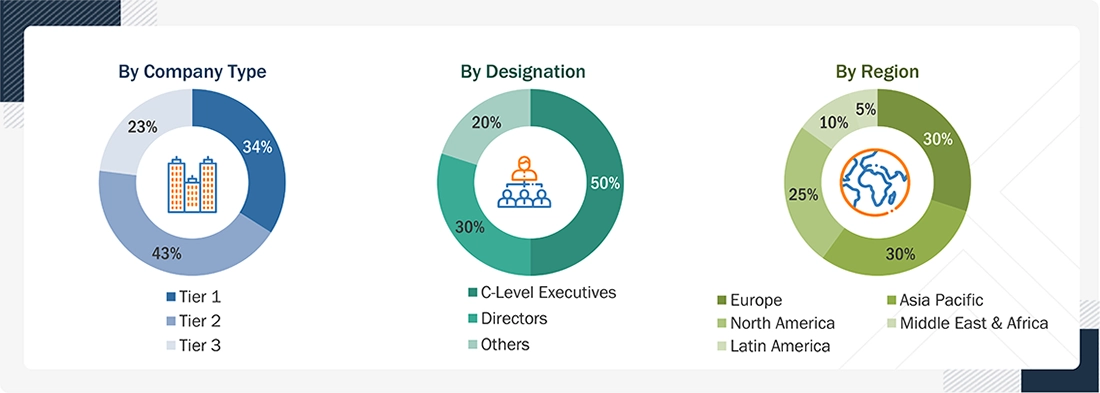
Breakdown Of Primary Interviews

Smart Cities Market Size, and Share

Note: Tier 1 companies have revenues over USD 1 billion, Tier 2 companies have revenues between USD 500 million and 1 billion, and Tier 3 companies have revenues less than USD 500 million.
Other designations include sales managers, marketing managers, and product managers.
Source: Industry Experts

To know about the assumptions considered for the study, download the pdf brochure

Market Size Estimation

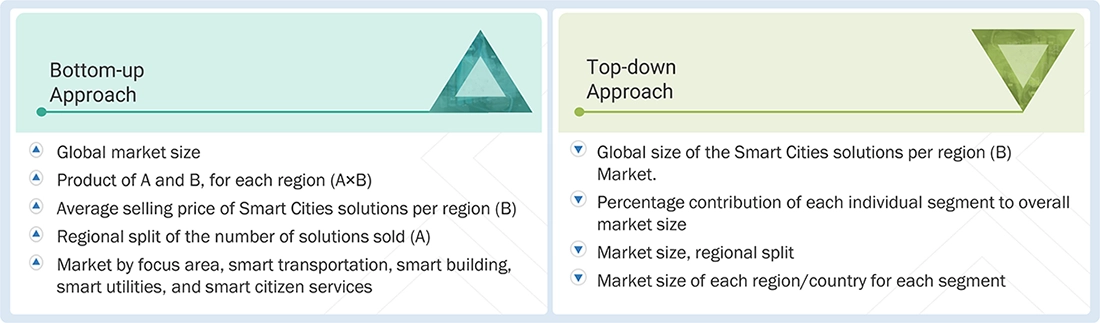
Both top-down and bottom-up approaches were used to estimate and validate the total size of the smart cities market. These methods were also used extensively to estimate the size of various sub-segments in the market.

Smart Cities Market: Top-Down and Bottom-Up Approach

Smart Cities Market Top Down and Bottom Up Approach

Data Triangulation

The smart cities market was split into several segments and sub-segments after determining the overall market size from the above estimation process. To complete the overall market engineering process and arrive at the exact statistics for all segments and sub-segments, data triangulation and market breakdown procedures were used, wherever applicable. The data was triangulated by studying various factors and trends from the demand and supply sides. The smart cities market size was validated using top-down and bottom-up approaches.

Market Definition

The European Union defines a smart city as a place where traditional networks and services are made more efficient with the use of digital solutions for the benefit of its inhabitants and businesses.

A smart city goes beyond the use of digital technologies for better resource use and fewer emissions. It means smarter urban transport networks, upgraded water supply and waste disposal facilities, and more efficient ways to light and heat buildings. It also means a more interactive and responsive city administration, safer public spaces, and meeting the needs of an aging population.

Key Stakeholders

  • National/State Governments
  • Municipal Authorities
  • Real-estate Developers
  • Information Technology (IT) Solution Providers
  • Platform Providers
  • System Integrators
  • Telecom Service Providers
  • Networking Solution Providers
  • Utility Companies
  • Transportation Service Providers
  • Independent Software Vendors (ISVs)
  • Network Equipment Providers
  • Communication Service Providers (CSPs)

Report Objectives

  • To determine, segment, and forecast the global smart cities market based on focus area, smart transportation, smart utilities, smart building, smart citizen services, and region in terms of value
  • To forecast the size of the market segments to five main regions: North America, Europe, Asia Pacific, Middle East & Africa, and Latin America
  • To provide detailed information about the major factors (drivers, opportunities, threats, and challenges) influencing the growth of the smart cities market
  • To study the complete value chain and related industry segments and perform a value chain analysis of the smart cities market landscape
  • To strategically analyze the macro and micro markets to individual growth trends, prospects, and contributions to the total smart cities market
  • To analyze the industry trends, patents, and innovations related to the smart cities market
  • To analyze the opportunities for stakeholders by identifying the high-growth segments of the smart cities market
  • To profile the key players in the market and comprehensively analyze their market share/ranking and core competencies
  • To track and analyze competitive developments, such as mergers & acquisitions, product launches & developments, partnerships, agreements, collaborations, business expansions, and Research & Development (R&D) activities

Available customizations:

With the given market data, MarketsandMarkets offers customizations based on the company’s specific needs. The following customization options are available for the report:

Geographic Analysis

  • Further break-up of the Asia Pacific market into countries contributing 75% to the regional market size
  • Further break-up of the North American market into countries contributing 75% to the regional market size
  • Further break-up of the Latin American market into countries contributing 75% to the regional market size
  • Further break-up of the Middle East & African market into countries contributing 75% to the regional market size
  • Further break-up of the European market into countries contributing 75% to the regional market size

Company Information

  • Detailed analysis and profiling of additional market players (up to five)


Key Questions Addressed by the Report

What is the definition of the smart cities market?

A smart city is a place where traditional networks and services are made more efficient through digital solutions, benefiting its inhabitants and businesses. A smart city goes beyond the use of digital technologies for better resource use and fewer emissions. It means smarter urban transport networks, upgraded water supply and waste disposal facilities, and more efficient ways to light and heat buildings. It also means a more interactive and responsive city administration, safer public spaces, and meeting the needs of an ageing population.

What is the projected size of the Smart Cities Market by 2032?

The global Smart Cities Market is projected to grow from USD 806.32 billion in 2026 to USD 1,796.22 billion by 2032, registering a compound annual growth rate (CAGR) of 14.3% during 2026–2032. Growth is supported by urbanization, climate resilience priorities, and investment in intelligent transportation, energy-efficient buildings, connected utilities, digital healthcare, and e-governance.

Which technologies are shaping the growth of the Smart Cities Market?

Artificial intelligence (AI), the Internet of Things (IoT), 5G, digital twins, and cloud platforms are shaping smart city development. These technologies help municipalities and infrastructure operators connect urban systems, collect and analyze data, improve real-time decision-making, and enhance the efficiency of transportation, utilities, buildings, and public services while supporting sustainable and resilient urban operations.

Which solution is expected to register the fastest growth in the smart transportation segment?

Passenger information management is expected to register the fastest growth in the smart transportation segment. These systems use real-time data, IoT, and AI to provide commuters with timely information about transit schedules, delays, and routes through mobile applications, digital signage, and in-vehicle systems. Integration with smart ticketing and mobility-as-a-service platforms further improves accessibility and the transit experience.

Which type is expected to account for the largest share of the smart building segment?

Commercial smart buildings are estimated to account for the largest share of the smart building segment during the forecast period. Offices, retail establishments, and corporate parks are adopting building management systems to optimize HVAC, lighting, and energy consumption. Smart access systems, AI-based space optimization, and IoT sensors also support security, occupant comfort, and lower operating costs.

Which region is projected to register the highest growth in the Smart Cities Market?

Asia Pacific is projected to register the highest CAGR in the Smart Cities Market during the forecast period. Rapid urbanization, expanding middle-class populations, and government investment in digital infrastructure are supporting adoption. Initiatives such as India's Smart Cities Mission and China's New Urbanization Plan, alongside 5G expansion and public-private collaboration, are accelerating regional development.

Who are the key players operating in the Smart Cities Market?

Major vendors covered in the Smart Cities Market include Cisco, IBM, Siemens, Microsoft, Hitachi, Schneider Electric, Huawei, NEC Corporation, Honeywell, and ABB. These companies offer technologies and solutions across connected infrastructure, digital platforms, utilities, buildings, transportation, and citizen services. Their strategies include collaborations, acquisitions, product launches, partnerships, agreements, and geographic expansion.

What factors are driving investment in the Smart Cities Market?

Investment is being accelerated by rapid urbanization, climate resilience priorities, and rising expectations for accessible public services. Cities are investing in intelligent transportation, energy-efficient buildings, connected utilities, digital healthcare, and e-governance. AI, IoT, 5G, digital twins, and cloud platforms create opportunities to improve operational efficiency and deliver measurable benefits to citizens and infrastructure operators.

Personalize This Research

  • Triangulate with your Own Data
  • Get Data as per your Format and Definition
  • Gain a Deeper Dive on a Specific Application, Geography, Customer or Competitor
  • Any level of Personalization
Request A Free Customisation

Let Us Help You

  • What are the Known and Unknown Adjacencies Impacting the Smart Cities Market
  • What will your New Revenue Sources be?
  • Who will be your Top Customer; what will make them switch?
  • Defend your Market Share or Win Competitors
  • Get a Scorecard for Target Partners
Customized Workshop Request

Custom Market Research Services

We Will Customise The Research For You, In Case The Report Listed Above Does Not Meet With Your Requirements

Get 10% Free Customisation

TESTIMONIALS

Growth opportunities and latent adjacency in Smart Cities Market

avtar

Harold

Jul, 2026

How are smart city initiatives aligning with growing ESG priorities across urban infrastructure projects?.

avtar

Lawrence

Jul, 2026

How are AI technologies improving renewable energy management within smart city projects?.

avtar

Archer

Jul, 2026

The report mentions increasing focus on sustainability and energy optimization. Are smart energy management and renewable integration becoming core components of smart city strategies?.

avtar

Ellison

Jul, 2026

With growing investments in smart mobility, are intelligent transportation systems and connected traffic management among the fastest-growing segments within the smart cities market?.

THIS REPORT TELLS YOU

How big the Smart Cities market is, and who leads it.

GROWTHIQ TELLS YOU NEW

Where your company should play next, and who is taking your share.

Get your company's view of this market. Free snapshot.

DMCA.com Protection Status
popup img